The problem
An order check is small enough to understand, but it still needs a clear contract: which values enter the calculation, what happens at the limit, and what the reviewer can inspect afterwards. A plausible explanation is not a substitute for those checks.
What was done in this recorded example · 4 stages
State the rule
Calculate quantity multiplied by price in integer pence. Accept a valid order at or below its limit, reject a higher value and refuse invalid input.
Author the application
With gpt-6.1-sol configured at low reasoning effort, the recorded session authored four application nodes plus an input type, generator and verifier.
Generate and run
The assistant invoked the prepared local compiler helper. Fluxtion emitted Java and GraphML, then the runtime-only verification checked seven decisions and four invalid constructions.
Check the evidence separately
Reviewer-authored checks independently exercised nine valid cases with exact audit facts, five invalid constructions and a subsequent valid event. The original seven captured records were also checked against the requirements.
Stated requirements lead to authored components and an application definition. Fluxtion generates their coordination, and the runtime records the values behind each decision. Separate checks compare those observations with the agreed requirements.
The same order is rejected twice. A different limit changes the answer.
In the captured run, 10 units at GBP 12 produce a GBP 120 order. With a GBP 100 limit it is rejected, including a second identical input. With a GBP 150 limit it is accepted. Equality is accepted. All seven decision cases match the stated rule; four invalid or overflowing inputs are refused.
| Requirement | Observed check |
|---|---|
| Calculate quantity × unit price | 10 × GBP 12 = GBP 120 |
| Reject an order above its limit | GBP 120 / GBP 100: REJECTED |
| Accept at or below the limit | GBP 120 and GBP 150 limits: ACCEPTED |
| Repeat the same input consistently | Both identical inputs: REJECTED |
| Refuse invalid or overflowing input | Four invalid inputs refused |
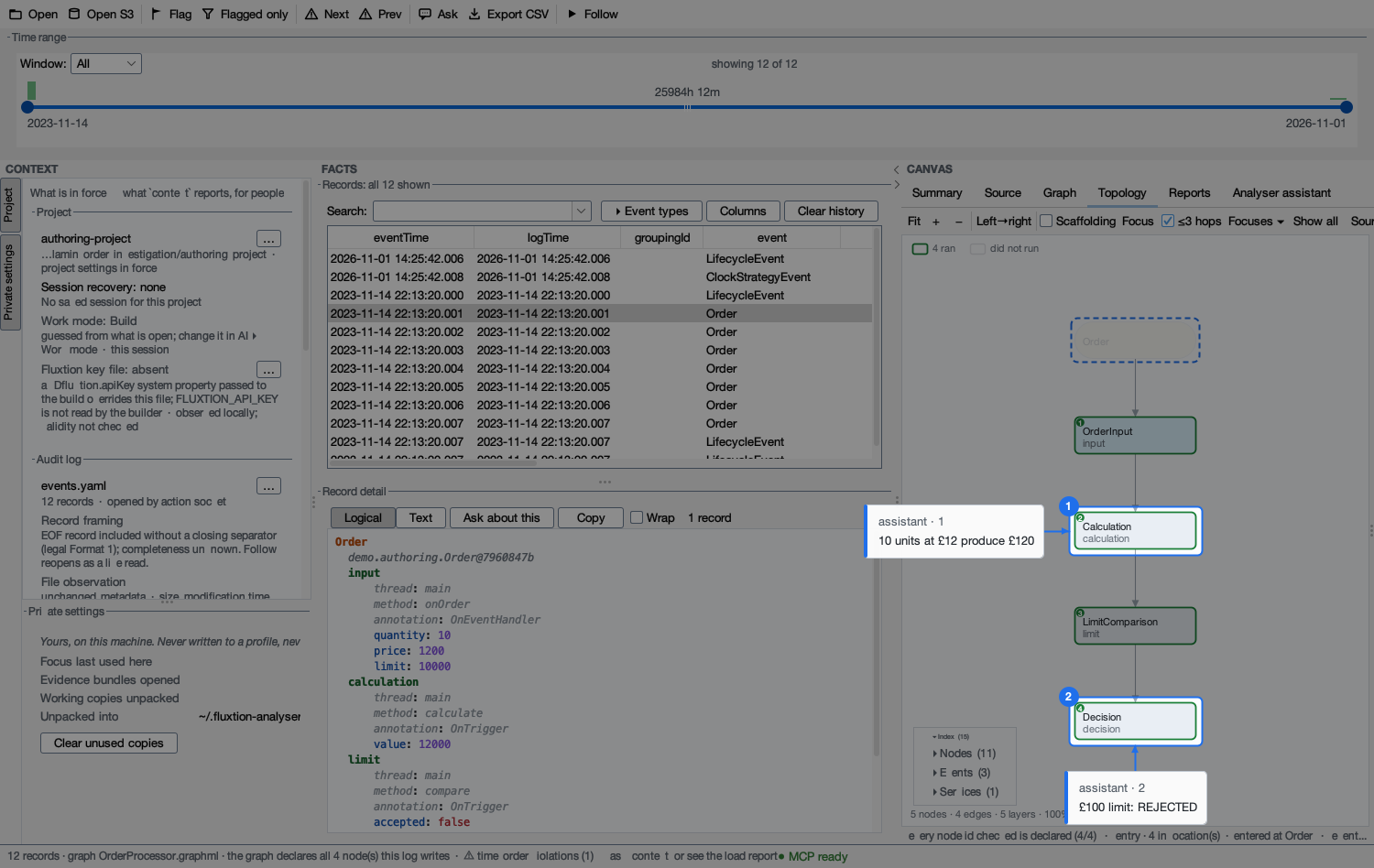
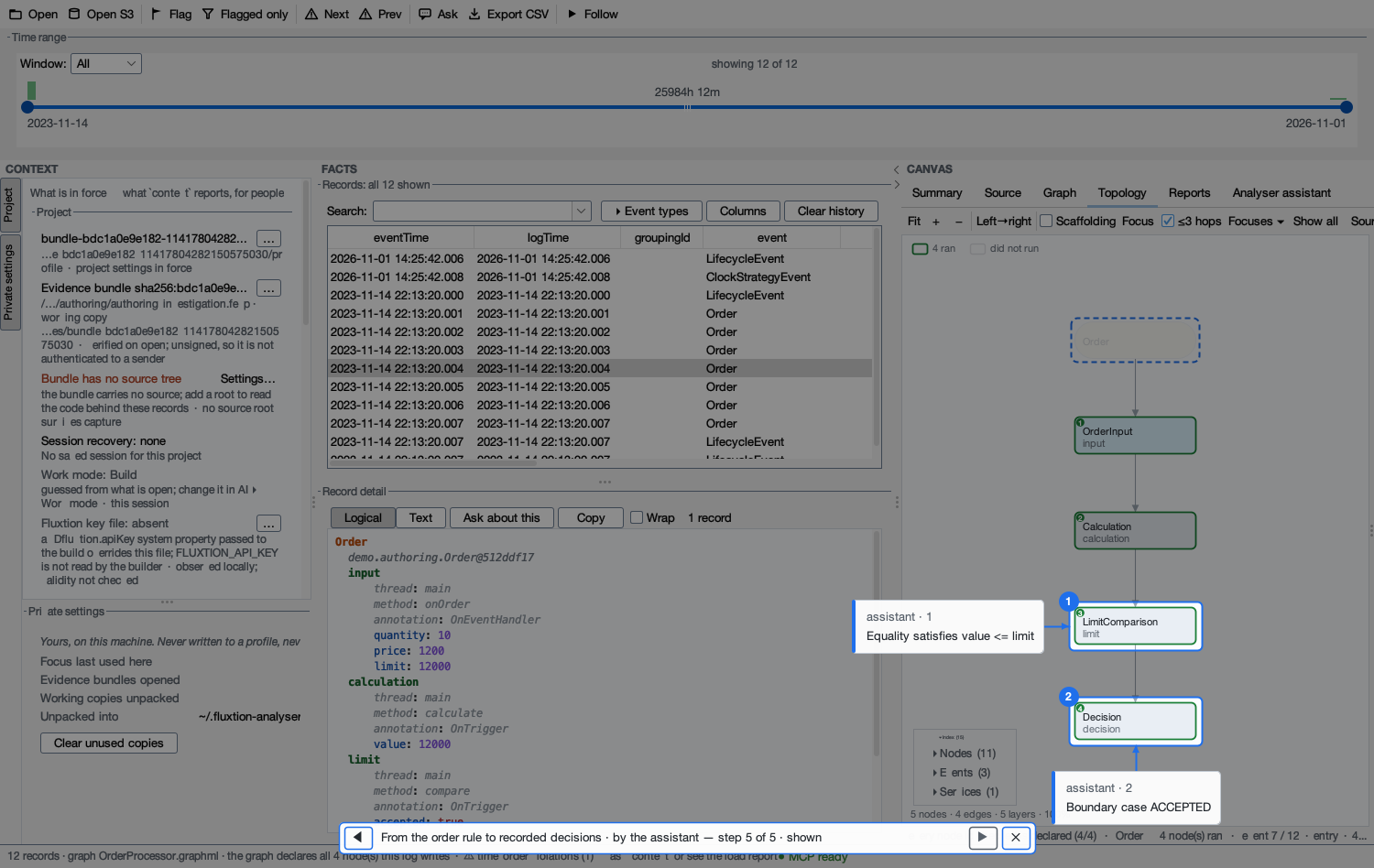
To reopen the investigation in the Analyser, save both files in the same folder.
Why this matters
The request, visible conversation, application graph and test outcomes remain available for review. A reviewer can compare the intended rule with what the generated application actually did, including repeated input and boundary cases.
The Analyser created an evidence bundle for reopening this investigation. The HTML reel and PDF provide a readable account to share.
Apply it to your process
A pilot could replace this small rule with one representative approval or operational control. Your team supplies examples, exceptions and acceptance criteria; together we assess the implementation and its evidence before deciding whether to adopt, extend or stop.
See the five-stage pilot journeyTechnical appendix: reproduce the result and inspect the files
Run this example
Reproduction prerequisites
Use Python 3 and JDK 21. Download the public, version-pinned runtime below; no account or compiler credit is required for this download or these reproduction runs.
Download fluxtion-runtime 1.1.3 · Published Maven metadata
Maven coordinates: com.telamin.fluxtion:fluxtion-runtime:1.1.3.
The runtime’s published metadata declares AGPL-3.0. Its terms are separate from the example code’s Apache 2.0 licence. See the published licence and product licensing.
Download into the unzipped example directory:
curl -fL https://repo.repsy.io/mvn/fluxtion/fluxtion-public/com/telamin/fluxtion/fluxtion-runtime/1.1.3/fluxtion-runtime-1.1.3.jar \
  -o fluxtion-runtime-1.1.3.jar
Expected SHA-256 (the runner checks this before compiling):
2bd45eb62409403422d5a676a7ad177f1984aa80dc399c20ceb6b467eab4b775Unzip this example’s standalone source package and run from its authoring-session directory with Python 3, JDK 21 and the separately supplied reviewed runtime:
Download this example’s source and reproduction package
python3 run.py \
  --runtime ./fluxtion-runtime-1.1.3.jar \
  --out results
The runner verifies the runtime and original trial manifest, compiles the actual generated Java and authored nodes, then executes the model’s verifier and separate reviewer checks. The original decision CSV must match. No model or generation request is made.
The recorded local-build.sh is redacted historical context, not a portable installation script. Use run.py for reproduction. Regeneration needs separately configured compiler access.
This is the actual fresh processor from the recorded trial. Four application nodes and their definition were authored without a previous order implementation; Fluxtion generated the coordination. The curated Java was rebuilt after its owner-authorized demo licence notices were applied.
Captured files
- decisions.csv
- events.yaml
- summary.txt
- original-evidence-review.json
- session-receipt.json
- manifest.json
- Matching application graph
- Read the recorded authoring conversation
- Visible conversation as JSON
- Configured model, counts and session scope
- Authored application definition
- Separate reviewer results
- Original audit checked against requirements
- Open this application’s evidence bundle
- Capture method and reopen instructions
- Actual Analyser tool requests and responses
- Analyser-exported requirements observations PDF
- Bundle verification receipt
- Investigation artifact hashes
Detailed walkthrough
Prepare the recorded task
The session received requirements, generic SDK notes, cached dependencies and an offline compiler helper. No previous order implementation was supplied.
Record the actual conversation
The configured model was gpt-6.1-sol with low reasoning effort in CLI 0.164.0. One user prompt led to one completed CLI turn, three visible assistant messages and eight completed command actions. A CLI turn is not one underlying inference request.
Author four application nodes
OrderInput accepts events, Calculation computes the amount, LimitComparison applies the rule and Decision publishes outcomes. Order.java supplies input validation; GenerateApplication and VerifyApplication supply generation and checks. All seven Java files were newly authored.
Generate and execute
The first local generation and verification attempts passed. The emitted OrderProcessor and its original events.yaml are included, with separate source and artifact hashes. Initial lifecycle timestamps precede application clock configuration.
Verify requirements independently
The separate ReviewerChecks harness checks expected results, exact captured quantity/price/limit/value/decision fields, repeat dispatch, invalid inputs and a subsequent valid event. It is separate from the model-authored verifier.
Preserve the actual record
The curated conversation retains visible messages and completed command results in order. Local roots and expanded compiler classpaths are redacted; private reasoning and credentials are excluded. The full session receipt documents counts, setup and timing scope.
Scope and interpretation
- One prepared authoring demonstration, not a benchmark or general success-rate estimate. Generic SDK notes, a compiler helper and cached dependencies were supplied; no previous order implementation was provided.
- One completed CLI turn contains multiple visible messages and command actions. The number of underlying model requests is not exposed. The receipt’s elapsed time excludes prepared setup and is not a total-effort measure or timing guarantee.
- The model-authored verifier checks seven valid cases and four invalid constructions. The separate reviewer checks nine valid cases, five invalid constructions and recovery. These establish the tested requirements, not universal correctness or human acceptance.
- The original audit contains lifecycle wall time before the application clock is configured. Compare record values and event order rather than treating these mixed timestamps as a production chronology.
- The subsequent Analyser capture used its isolated REST action socket with hosted OpenAI inference. Its bundle contains the original trial audit and graph, not the additional reviewer events or source tree. It was verified and reopened on the same machine. Ordinary member hashes do not authenticate origin or deployed-binary identity.
Example code is released under Apache 2.0. Runtime, third-party and general customer-output terms remain separate. Member hashes compare bytes; they do not certify a business decision.
- Read and download
- No registration. Pages, PDFs and source package are public for released examples.
- Run the supplied code
- No Telamin sign-in. Python 3, JDK 21 and the separately supplied runtime 1.1.3 JAR.
- Use the playground
- Pre-generated order example runs signed out. Its code editor is best on a desktop or laptop. The first run downloads a Java runtime.
- Generate or interpret
- Your own processor requires sign-in and allowance. Review data flows and licensing before generating.
Continue exploring
Follow the same rule into a real Analyser investigation of the deliberately wrong comparison.
Investigate and fix