The problem
A £105 order receives a 10% discount. Merchandise is now £94.50, below the £100 free-shipping threshold. But the application charges no shipping and releases the order against a £97 credit limit. Which rule caused that result, and can it be changed without breaking the rest of the process?
What was done in this recorded example · 5 stages
Open the support case
Start with the reported decision and its original investigation bundle.
Explain the mismatch
Connect £94.50 merchandise, missing shipping and the £97 limit to the Shipping.java comparison.
Approve the repair
The human authorizes the focused change and regression checks.
Extend and test
Add one handling-charge node and one event handler, then test boundaries, non-propagating updates and recovery.
Return the evidence
Inspect separate original, repaired and extended investigations with the source and tests.
Keep the original intake, the approved repair and the extension as separate revisions. Each saved investigation contains that revision’s captured log and graph. The code and runnable tests travel in the source package.
One repaired comparison. Then a visible structural change.
The approved repair compares the shipping threshold with discounted merchandise: £94.50 + £5 shipping = £99.50, so the order is rejected against a £97 limit. That repair leaves the generated topology unchanged. The subsequent candidate adds a HandlingCharge node and a HandlingFeeUpdate event on the existing Policy node, producing a new 12-node graph.
| Case or component | Recorded result |
|---|---|
| Original recorded decision | £94.50 total; RELEASED — inconsistent with the shipping requirement |
| Approved repair | £99.50 total; REJECTED_CREDIT |
| Repair checks | 85 assertions pass; the original fails the shipping regression |
| Independent boundary checks | 45 assertions pass |
| Extended graph | 12 processing nodes; four business event types |
| Extension capture | 9 order attempts; 10 updates; 8 publications; 23 audit records |
| Failure and recovery | Overflow publishes nothing; fee reset and the next order succeed on the same instance |
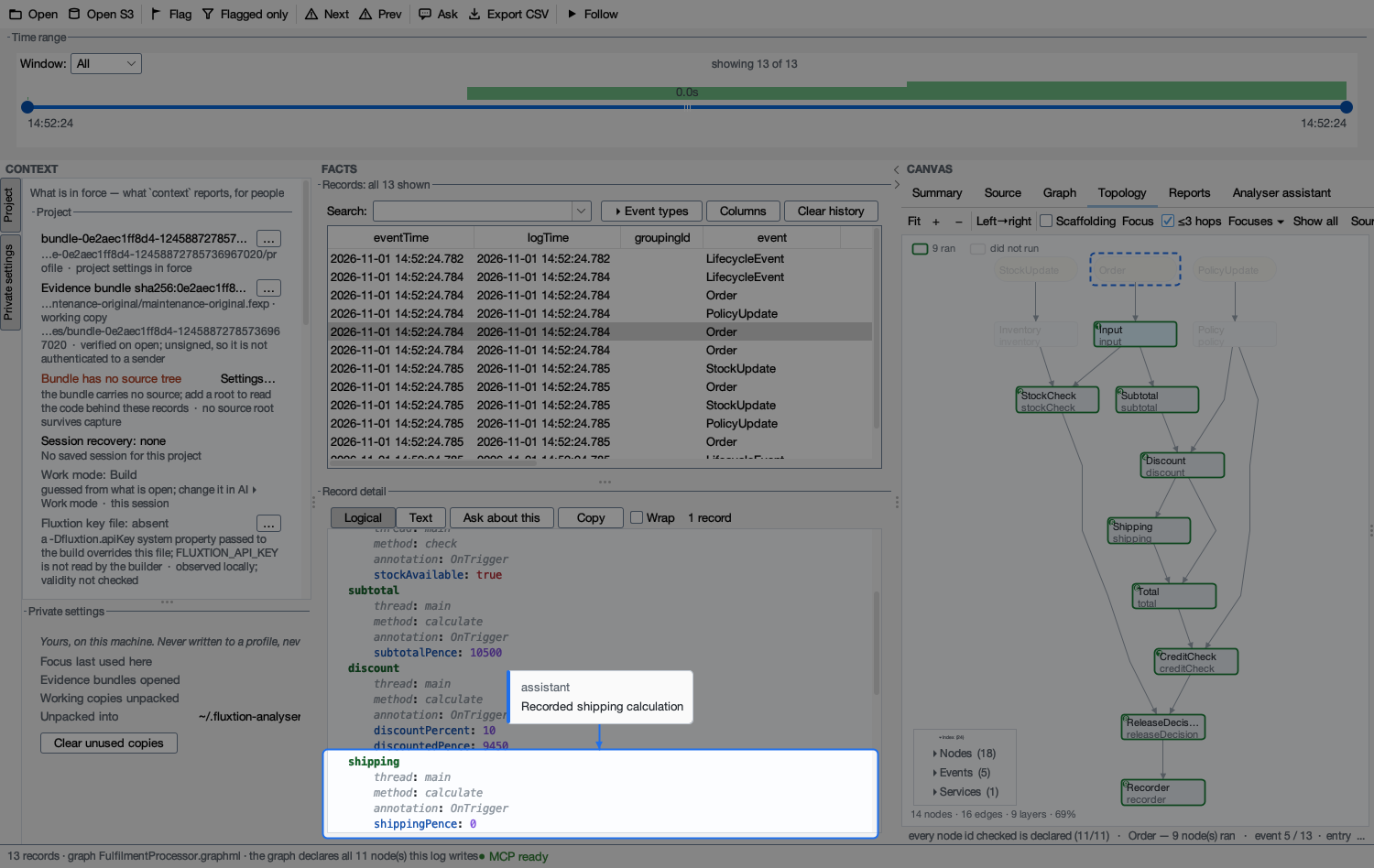
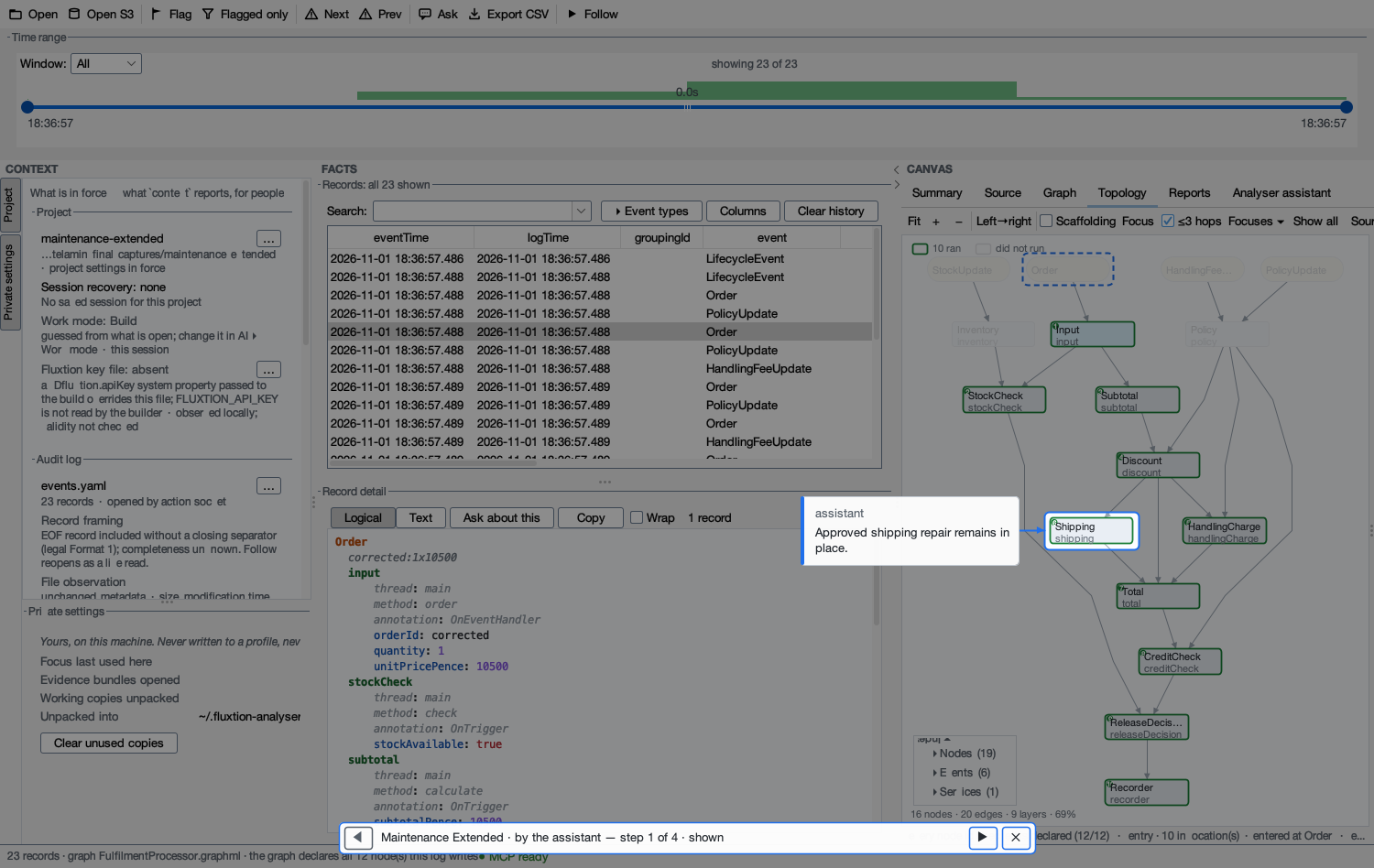
Original: recorded incident. Repaired: human-approved shipping correction. Extended: proposed handling-charge extension, not owner-approved as a business rule.
View the reel directly in your browser. For an offline handoff, save the HTML reel and investigation bundle in the same folder.
Why this matters
The team can see both the small repair and the larger structural change, inspect why each result changed, and hand the same context to another reviewer. This demonstration measures checks and observed outcomes; it does not establish diagnostic time or cost savings.
The Analyser created an evidence bundle for reopening this investigation. The HTML reel and PDF provide a readable account to share.
Apply it to your process
Bring one representative process, its expected outcomes and failure cases. Agree the checks and evidence before evaluating a candidate change; finish with an adopt, extend or stop decision.
See the five-stage pilot journeyTechnical appendix: reproduce the result and inspect the files
Run this example
Reproduction prerequisites
Use Python 3 and JDK 21. Download the public, version-pinned runtime below; no account or compiler credit is required for this download or these reproduction runs.
Download fluxtion-runtime 1.1.3 · Published Maven metadata
Maven coordinates: com.telamin.fluxtion:fluxtion-runtime:1.1.3.
The runtime’s published metadata declares AGPL-3.0. Its terms are separate from the example code’s Apache 2.0 licence. See the published licence and product licensing.
Download into the unzipped example directory:
curl -fL https://repo.repsy.io/mvn/fluxtion/fluxtion-public/com/telamin/fluxtion/fluxtion-runtime/1.1.3/fluxtion-runtime-1.1.3.jar \
  -o fluxtion-runtime-1.1.3.jar
Expected SHA-256 (the runner checks this before compiling):
2bd45eb62409403422d5a676a7ad177f1984aa80dc399c20ceb6b467eab4b775Unzip the package and run from its complex-maintenance directory:
Download this example’s source and reproduction package
python3 run.py \
  --runtime ./fluxtion-runtime-1.1.3.jar \
  --out results
The runner verifies the public runtime checksum, compiles the supplied generated Java and executes the checks locally. No generation credit, model request or network service is used. Use a new output directory.
Source, supplied generated code, test harnesses and README are included. Runtime terms remain separate from the Apache 2.0 demonstration source.
Generated orchestration is included for offline execution. No hosted compiler is called by reproduction. Changing topology requires regeneration.
Captured files
- summary.json
- commands.json
- conversation.json
- Matching application graph
- Extended candidate investigation bundle
- Extended candidate saved investigation reel
- Extended candidate reopening receipt
- Approved repair investigation bundle
- Approved repair saved investigation reel
- Approved repair reopening receipt
- Original intake investigation bundle
- Original intake saved investigation reel
- Original intake reopening receipt
Detailed walkthrough
Receive the intake
A synthetic Jira-ready ticket, source, generated graph and evidence bundle were supplied. Nothing was posted to Jira. The fresh session received no creator oracle or previous conversation.
Diagnose from recorded facts
The fresh model found Shipping.java tested the pre-discount subtotal. Its Analyser MCP calls were refused by the tool approval policy, so this diagnosis used the supplied files. The supervising assistant independently checked record 4 in the isolated Analyser.
Obtain actual human approval
The owner replied “Approve the repair and tests”. The visible conversation includes that real approval. The one-expression repair and boundary tests followed.
Add the requested structural extension
The owner requested a new intermediate node and a new event/handler. The assistant proposed a configurable handling charge as the concrete local candidate. That particular business rule remains for the owner to review.
Review and preserve evidence
An independent agent reran the tests and found a recovery test that swallowed assertion failures. The gate now fails on those errors and requires the expected 80-assertion completion. Original session messages and captures are preserved separately.
Scope and interpretation
- Synthetic unfamiliar-code exercise, not a real customer incident or a formal blinded study. The creator knew the fault; the fresh diagnosis session was not given its oracle.
- The original session’s MCP access was blocked. Analyser inspection and exports were performed separately by the supervising assistant through the local action API; no successful fresh-model MCP workflow is claimed.
- Handling charge is a proposed local extension, not an owner-approved business rule. Human approval in the transcript applies to the shipping repair and tests.
- The failure/recovery checks cover this synchronous fixture, not transaction rollback, arbitrary failures or production resilience.
- Three model task prompts and actual visible messages are available; CLI default model/effort were not recorded. No token, cost or model-level comparison is claimed.
- Bundles contain selected logs, matching graphs and saved investigations. They are unsigned and do not carry the complete source or execute a replay.
Example code is released under Apache 2.0. Runtime, third-party and general customer-output terms remain separate. Member hashes compare bytes; they do not certify a business decision.
- Read and download
- No registration. Pages, PDFs and source package are public for released examples.
- Run the supplied code
- No Telamin sign-in. Python 3, JDK 21 and the public fluxtion-runtime 1.1.3 JAR.
- Use the playground
- Pre-generated order example runs signed out. Its code editor is best on a desktop or laptop. The first run downloads a Java runtime.
- Generate or interpret
- Your own processor requires sign-in and allowance. Review data flows and licensing before generating.
Continue exploring
Replay goes further: reproduce captured input events from a declared starting state and compare an intentional rule change.
Replay and compare