The problem
A sequence of orders changes its limits, stock and dependency availability over time. Checking isolated inputs is not enough: the order of updates and the starting conditions matter. A reviewer needs to distinguish changes caused by the code from changes caused by the environment.
What was done in this recorded example · 5 stages
Record the session
Save actual incoming commands and the explicit starting-state contract.
Reproduce it
Start a fresh application process using the saved inputs.
Compare the records
Check exact host observations and selected audit records.
Evaluate a change
Apply a stricter limit rule and identify the two changed decisions.
Share the result
Hand over the runner, inputs, comparison and saved investigations.
Capture inputs and starting conditions, execute the matching build, compare the defined observations, then inspect an intentional changed build. The application runner performs the replay; the Analyser opens the resulting records and saves investigations.
The same build matches. A stricter rule changes exactly two decisions.
The host saves each command before dispatch and captures its initial state. The original input producer is then deleted. Fresh JVMs replay only that saved journal and state. All 16 host observations and all nine order audit records match. Changing the limit rule from “at or below” to “below” rejects exactly the two equality orders; the other observations retain their expected behaviour.
| Case or component | Recorded result |
|---|---|
| Captured inputs | 16 commands: nine orders and seven host-state updates |
| Starting conditions | Fresh processor; explicit limit, stock, risk availability and clock |
| Same-build host observations | 16 of 16 match |
| Resolved order inputs | 9 of 9 match |
| Selected order audit records | 9 of 9 match, including recorded node observations and injected clocks |
| Original execution | 8 decision publications and one synthetic dependency exception |
| Changed rule | 2 equality decisions change from ACCEPTED to REJECTED_LIMIT |
| Negative controls | Different state/order change behaviour; malformed state, sequence, overflow and clock mismatch are refused before execution |
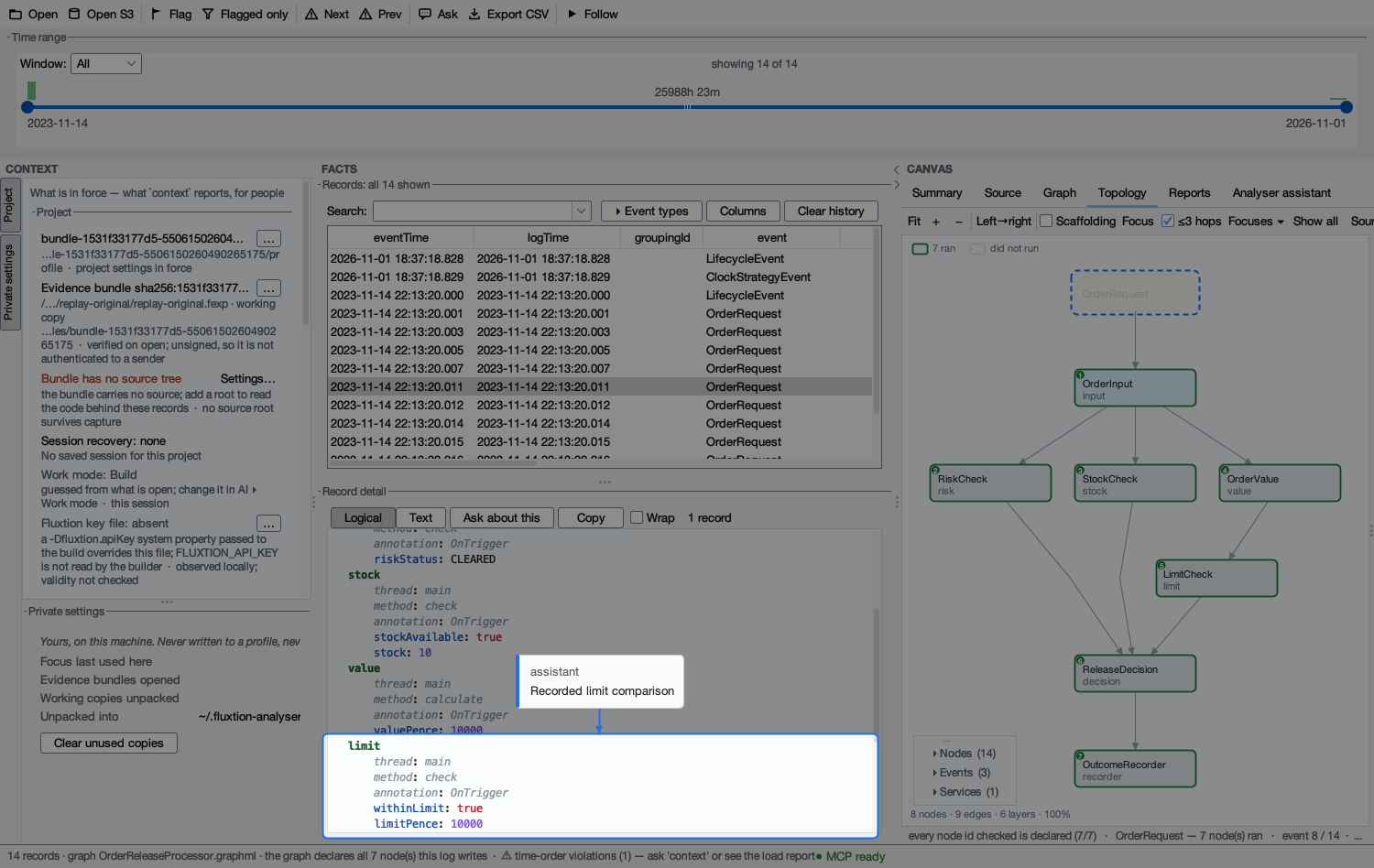
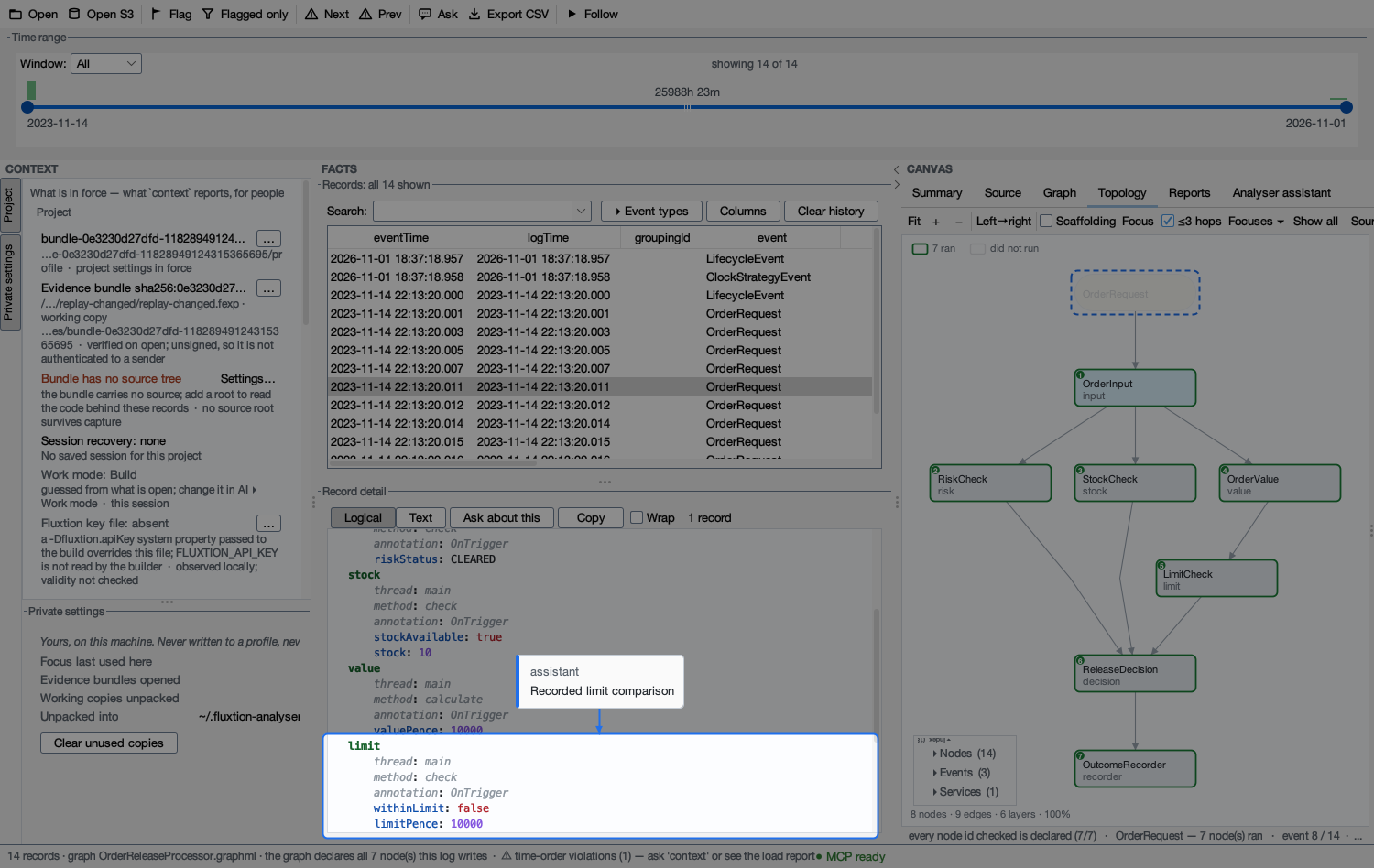
These reels show saved investigations. The application runner executes replay and compares the observations.
View the reel directly in your browser. For an offline handoff, save the HTML reel and investigation bundle in the same folder.
Why this matters
A reviewer can reproduce this captured scenario, see that state and event order matter, and identify the exact effects of a changed rule. In a pilot, the same discipline can support regression review and incident investigation when the necessary inputs and external conditions have been captured.
The Analyser created an evidence bundle for reopening this investigation. The HTML reel and PDF provide a readable account to share.
Apply it to your process
Bring one representative process, its expected outcomes and failure cases. Agree the checks and evidence before evaluating a candidate change; finish with an adopt, extend or stop decision.
See the five-stage pilot journeyTechnical appendix: reproduce the result and inspect the files
Run this example
Reproduction prerequisites
Use Python 3 and JDK 21. Download the public, version-pinned runtime below; no account or compiler credit is required for this download or these reproduction runs.
Download fluxtion-runtime 1.1.3 · Published Maven metadata
Maven coordinates: com.telamin.fluxtion:fluxtion-runtime:1.1.3.
The runtime’s published metadata declares AGPL-3.0. Its terms are separate from the example code’s Apache 2.0 licence. See the published licence and product licensing.
Download into the unzipped example directory:
curl -fL https://repo.repsy.io/mvn/fluxtion/fluxtion-public/com/telamin/fluxtion/fluxtion-runtime/1.1.3/fluxtion-runtime-1.1.3.jar \
  -o fluxtion-runtime-1.1.3.jar
Expected SHA-256 (the runner checks this before compiling):
2bd45eb62409403422d5a676a7ad177f1984aa80dc399c20ceb6b467eab4b775Unzip the package and run from its captured-replay directory:
Download this example’s source and reproduction package
python3 run.py \
  --runtime ./fluxtion-runtime-1.1.3.jar \
  --out results
The runner verifies the public runtime checksum, compiles the supplied generated Java and executes the checks locally. No generation credit, model request or network service is used. Use a new output directory.
Source, supplied generated code, test harnesses and README are included. Runtime terms remain separate from the Apache 2.0 demonstration source.
Generated orchestration is included for offline execution. No hosted compiler is called by reproduction. Changing topology requires regeneration.
Captured files
- summary.json
- commands.json
- audit-comparison.json
- captured-inputs.csv
- initial-state.properties
- observations.csv
- Matching application graph
- Changed build investigation bundle
- Changed build saved investigation reel
- Changed build reopening receipt
- Same-build replay investigation bundle
- Same-build replay saved investigation reel
- Same-build replay reopening receipt
- Original captured run investigation bundle
- Original captured run saved investigation reel
- Original captured run reopening receipt
Detailed walkthrough
Capture before dispatch
The host journals all 16 actual incoming synthetic commands before dispatch. Limit, stock and risk updates are host-owned; the processor receives resolved OrderRequest snapshots.
Remove the producer
The producer CSV is deleted before replay. Saved journal and starting-state bytes are retained and checked by hash.
Run in fresh JVMs
The same compiled build runs from a fresh processor with its captured initial host state. No network services or irreversible external effects are invoked.
Compare meaningful observations
Compare all 16 host rows, 9 resolved inputs and 9 OrderRequest audit records, including injected event/log/end clocks. Initialization, lifecycle and clock-install records are outside this comparison.
Change one rule
Compile a second build changing <= to <. Only the two equality decisions change; this is an intentional alternative requirement, not a claimed defect fix.
Inspect and hand over
The Analyser saves original, same-build replay and changed-build investigations. Downloadable source and inputs supply the execution path separately from the unsigned bundles.
Scope and interpretation
- Synthetic captured-input session, not replay of a production incident. Starting state means a fresh processor plus explicit host values, not arbitrary heap checkpointing.
- Risk availability is a controlled synthetic dependency. Unrecorded service responses, randomness, uncontrolled clocks, shared concurrent state or irreversible effects require separate capture/control.
- Nine order audit records are compared. Raw complete logs are not byte-identical; initialization and clock-install records contain wall-clock/object-identity differences.
- The Analyser screenshots contain mixed initialization and fixture clocks. Their displayed multi-year span is not an elapsed-time measurement; follow record order.
- The application runner executes replay. Opening a bundle or stepping through an HTML reel only reopens the saved investigation.
- Member hashes detect changed contents; they do not authenticate the sender or attest an actual production deployment.
Example code is released under Apache 2.0. Runtime, third-party and general customer-output terms remain separate. Member hashes compare bytes; they do not certify a business decision.
- Read and download
- No registration. Pages, PDFs and source package are public for released examples.
- Run the supplied code
- No Telamin sign-in. Python 3, JDK 21 and the public fluxtion-runtime 1.1.3 JAR.
- Use the playground
- Pre-generated order example runs signed out. Its code editor is best on a desktop or laptop. The first run downloads a Java runtime.
- Generate or interpret
- Your own processor requires sign-in and allowance. Review data flows and licensing before generating.
Continue exploring
The maintenance example shows a diagnosis, real human approval, focused correction and a new intermediate node.
Maintain an application